Pages

Sunday, 15 May 2011

I am a camera

"I am a camera with its shutter open, quite passive, recording, not thinking. Recording the man shaving at the window opposite and the woman in the kimono washing her hair. Some day, all this will have to be developed, carefully printed, fixed."


This is one of the memorable lines from a fantastic play I saw on friday night by John Van Druten, inspired by Christopher Isherwood's Berlin novel. It is showing at the wonderful small theatre above the Rosemary Branch pub along the canal from my flat. 

still from the film I am a Camera


It was a funny and poignant portrayal of two close friends trying to make sense of being artists in Berlin against the backdrop of the rise in fascism. The lead character who was the inspiration for Sally Bowles in Caberet is a crazy, drunken unsuccessful cabaret singer, jumping from rich guy to richer guys, buzzing with energy and overenthusiastic gushing. She's like a more wild, less good looking Holly Golightly. Someone you'd like to throw a decadent party with.

Cabaret

Catch it before it whirls off the stage. Its a great night out with brilliant performances from the whole cast.

Saturday, 14 May 2011

Boys chatting football, girls chatting love

In the office while making a cup of coffee this week, I was impressed by a professional and serious discussion taking place about strategy by two of the few men in the office. They sound so serious, expert and intelligent discussing tactics and management.  It was only after a few minutes that I realised they were discussing football, a hobby. It was a way of having small talk and bonding (with the few other men around) but sounded more informed and intelligent than when they discuss work – their actual expertise. 

I am also amazed at the amount of chat by women about relationships, their love lives, family, parents, or friends. Not just in the office, but in the pub, over coffee, walking in the park. The analysis is often as in-depth as the football chat.

This is an old cliché. That men talk about football and women talk about emotions and relationships. Its obviously an absurd generalisation and stereotype. There are lots of women that love discussing sport. And I discuss relationships and love with my male friends just as much as with my female friends. Sometimes more.
What is interesting though is how these habits are ascribed gender characteristics. Apparently men talk about football because they don’t do emotions and are better at facts and physical strength. And women talk about love because they are better at emotions and relationships.

But I really doubt how much this is down to differences in men and women and whether these are ‘male’ or ‘female’ characteristics. 

I have a longstanding argument with my husband about the differences between men and women. I think that there are little or no differences except physiological and biological differences and everything else is a process of social conditioning and learning what it is to be ‘male’ and ‘female’.  I sometimes go even further and argue that women are ascribed characteristics that prevent them from succeeding in life. My pet hate is multitasking. I think women are told they are naturally good at multitasking because it means they are more conditioned to perform menial jobs that require juggling lots of small things, and gets men off the hook with domestic chores.  Multitasking is a useful skill if you’re a mother juggling a baby, cooking and your long list of things to do. Its useful if you have an administrative role at work. But its no good if you need to focus and concentrate – an apparently ‘male’ trait. 

Gustavo thinks this is absurd and that men and women are clearly totally different and have different clusters of characteristics because of their gender.

Well a new report out this week by the think tank Demos put this debate on the political agenda. In the report Yvonne Roberts argues that there is evidence to support my theory that it’s all largely learned and conditioned by parenting, schools, and the wider society. She does point out that the scientific evidence is confusing and could be used to draw either conclusion.  

But while the jury is out on the evidence, I think it makes sense to try to keep gender away from characteristics as much as possible because of the constraints that this can put on equality, success and happiness.  The report argues that confusion about what is masculine and feminine restrains women (it’s not feminine to be tough at work and push for promotion, and women are good at multitasking so take the lion’s share of domestic work) and it also constrains men (its not masculine to be good at communication – a skill required to find job where there has been a shift from manufacturing to predominantly service economy).
 
Roberts adds some evidence to my previous post about the lack of good female role models in film.  In a study of Hollywood films released from 2006-2009 out of 5,554 lead characters only 29% were female and out of these a quarter were eye candy (compared to 4% of men). Roberts asks the same question I’ve been wondering, ‘So where are the positive heroines?’


Female Warrior, Greek statue

Interestingly a worthy new group, the Man Collective, has been set up to help men redefine what masculinity is. They feel they are part of a generation of men who feel lost and confused about their role now that they are no longer the ‘breadwinner’. 

I have many male friends struggling with this inherited idea they should be the ‘breadwinner’, earning enough to ‘take care of the family’, while in reality their partners are earning more or they aren’t in a position to earn enough to be defined as the ‘breadwinner’.  And this is despite the fact that they know rationally this is absurd, that we don’t live in that world anymore, and that one of the reasons they are attracted to the women they are with is because of their ambitious or success at work. 

Generations of women, rightly, have been trying to redefine femininity. Men need to do the same. And together we need to try to loosen the expectations of gender and allow for men that enjoy gossiping and women that run companies.

So an ambitious woman who is good at negotiating is not masculine, she’s just ambitious and good at her job. Or when a man is sensitive or makes an effort with his appearance he’s not ‘in touch with his feminine side’, he’s just more balanced and making an effort.

One of my favourite quotes from Roberts paper is from Edward Glover who gave an influential series of broadcasts for the BBC, arguing that women were naturally weak, needed domesticity to impose discipline, without which they would fall to ‘an orgy of knitting. Failing such solace they are inclined to eat their hearts out.’ 

Harsh! Although I quite like the image of an orgy of knitting….

Wednesday, 13 April 2011

Honey Bee Justice

On Friday my husband opened up his urban honey bee hives for UNICEF’s lovely youth climate ambassadors. He pointed out an interesting honey bee twist in generational fairness. 

When the hive starts to get crowded because there is an abundance of forage and good living conditions, instead of the younger bees leaving to start their own hive (as happens with humans), the elder bees leave with their queen. They leave, so that the younger bees can benefit from their accumulated resource, stability and wealth, and can create their own queen and their own colony from a strong position in an environment that is proven to support life sustainably.

In the honey bee world, parents leave their assets for their children at the point at which they most need them, in youth, rather than at the point at which the parents can no longer use them. The elder bees have the responsibility for moving on and starting from scratch, rather than expecting the children to. 


In my job at UNICEF UK I've have been thinking and writing about intergenerational justice in the context of climate change for a few years now. Children are being left with the burden of climate change largely caused by their parents’ high-carbon lifestyles. 

Children everywhere, but especially in developing countries are growing up in an environment that is more at risk of disasters, drought and instability, largely because of the lifestyles of previous generations, especially in developed countries. This goes against a core human instinct and a common shared value across many countries that parents try to leave improved opportunities and accumulated wealth for their children, or at least attempt not to leave the world in a worse state for their children.

There seems to be a growing interest in this as a framing concept  – not just for ascribing blame – but for finding an equitable solution. And it is uniting young people across countries with very different contexts with a shared sense of injustice and agency. 

Intergenerational justice seems to have now become a mainstream political concern in the UK. Ed Miliband recently stated that his overriding focus for the Labour party was fairness between generations, not just social and financial equity within generations. Ironically Nick Clegg and David Cameron, started with David Willets's publication of The Pinch, have also used the argument of fairness between generations to justify the budget deficit – on the grounds that it will reduce the burden of debt for future generations (some may argue that it might do the opposite for the current young generation as they have to take out greater loans to pay for higher tuition fees and waiting for job opportunities to pick up again - implemented by the very same David Willets as Eduacation Minister).

I met David Willets at an event on intergenerational justice and he said he hadnt really thought about solutions to the generational inequality in climate change.

If the solution proposed is along the ‘polluter pays’ principle – those most responsible should pay, compensating those least responsible but bearing the brunt.

Maybe honey bee justice would see be retired baby boomers downsizing and handing on their wealth, knowledge and resources to the younger generations creating the solutions to a more sustainable world. Or maybe just spending their life accumulating benefit, knowledge and assets in order to create an abundant, healthy world for their offspring to start with.

Thursday, 7 April 2011

Number 10 Frowning Street

I'm the cockroach Prime Minister of course, and I have to hurry back to Frowning Street....

At the end of the next short play, as our hero's (a mint leaf) friend 'scar' (a skull on top of a ghost) dies in his arms, he cries, "but are you dead or just asleep?"

And in another, the unwittingly funny moment when Sandy Salt (a sea shell) explains how her father, a 'no swimming' sign is trying to stop anyone going into her mother (the sea) as she had already had too many people in her.

Everyone knows children's imagination and insights can be moving and inspiring. But it was the genius idea of Scene and Heard to ask children (aged 10/11) to write short plays that professional adult actors would then perform. None of the words are edited and the actors did an amazing job of bringing trippy obscure characters to life, adding just enough humour but not undermining the children's sentiments.

It was one of the best nights out at the theatre I've ever. Check it out next time. I wish this was done more often. Helping children, particularly those from tougher parts of London, to express themselves, but also helping the audience to remember and enjoy children's unbridled imagination, innocence and wisdom.

Jenni Maitland in Here There and Everywhere at Theatro Technis

Tuesday, 22 March 2011

Where are all the heroes?

It is time for all the heroes to go home
if they have any, time for all of us common ones
to locate ourselves by the real things
we live by.
(William Stafford)

A Danish sub-titled drama, focusing solely on one crime throughout its 20 episodes, with Copenhagen city politics providing one of the main story lines, doesn't sound like addictive TV. But I've been hooked to The Killing on iplayer mainly because of the lead role, Detective Sarah Lund, played by Sofie Grabol.

I love the fact that she doesnt seem to suffer any guilt about not spending enough time with her family or son, totally immersed in her work in the 'male' stereotype. She's focused on her work 'because its important', but uses her feminine sense of intuition to stay ahead of her male co-workers. She's also rocking a casual I'm-too-focused-on-the-case-to-think-about-what-i-look-like look, while managing to create a fashion fuss about her awesome jumpers. But mostly I love the character because she's not there to be an aspirational role model even though you admire her stubborn focus and self assurance.  

Noticing that there is a season of heroic female leads at the BFI, perhaps we are slowly starting to realise there can be more archetypes in cinema that mother, lover, girl next door or psycho/witch. I like female leads not because they are the perfect role model but because they are an interesting, strong, unique and believable lead character. 

Sarah Lund in The Killing


Perhaps we shouldn't want female heroes any more than we think we want male heroes. An interesting article by Margaret Wheatley argues that its a mistake to want to be rescued by 'a hero'. Instead we need to realise that no hero can save us from either our own personal issues or by the many modern crises. She points out that solutions to problems will come from leaders who can bring out the ideas and experiences from a complex mass of people. These leaders need to be hosts rather than heroes. Because no one person can ever really be 'in charge' but only create the space for people to solve problems.

Heroes can only ever inspire from the grave. Living leaders inspire not by telling us what to do and how to live but by allowing us all to be heroic in our individually small ways.

Our
 heroic 
impulses 
most 
often 
are 
born 
from 
the 
best 
of 
intentions.
 We
 want
 to 
help, 
we 
want 
to 
solve, 
we 
want
 to 
fix.
 Yet 
this 
is 
the 
illusion
 of 
specialness,
 that 
we’re 
the

only 
ones 
who 
can 
offer 
help, 
service,
 skills.
 If 
we 
don’t 
do 
it, 
nobody
 will. 
This
 hero’s

path 
has 
only 
one 
guaranteed 
destination —we 
end
 up 
feeling
 lonely, 
exhausted
 and

unappreciated.


It
is
 time 
for 
all
 us 
heroes
 to 
go 
home
 because, 
if
 we 
do,
 we’ll
 notice 
that
 we’re 
not

alone.
 We’re
 surrounded 
by 
people
 just
 like 
us.
 They
 too 
want 
to
 contribute,
 they
 too

have 
ideas, 
they 
want 
to 
be 
useful 
to 
others 
and
 solve 
their 
own 
problems.


Truth 
be
 told,
 they 
never
 wanted
 heroes 
to 
rescue 
them 
anyway.


In fact Sarah Lund is a great example of why trying to be a hero is not something to aspire to. But you'll have to watch 20 episodes to understand that....So i'll leave you with a great shot of another great strong female lead on the big screen.


Jane Russell in The Paleface, on at the BFI

Monday, 14 March 2011

Suffering Jukebox

suffering jukebox such a sad machine 
your all filled up with what other people need 
and they never seem to turn you up loud 
there are a lot of chatterboxes in this crowd 

suffering jukebox in a happy town 
you're over in the corner breaking down 
they always seem to keep you way down low 
the people in this town don't want to know


Listening to this song with the fabulous lyrics made me think about DJs and record shops. 


There has been a huge shift in the music industry and the way people buy music. The old model of record labels is being challenged. Most record shops are closing and purchasing is now digital rather than on vinyl. Whether that is a sad loss or just an inevitable evolution is an old debate. But I'm interested in what's happening to the role of taste makers and selectors. With an exponential growth in stuff, access to a mass and maze of information, more and more people sharing their ideas and creations on-line, the selectors have arguably never been more important. But where do you find them?


When I used to DJ, I was definitely a selector rather than mixer. My mixing skills were pretty sketchy, mostly because of laziness, but also because I was more interested in spending my time digging for the best tunes, the songs that would get everyone smiling and sparks flying between two people eyeing each other over the dance floor. My favourite weekend browsing was in £1 boxes of vinyl at flea markets and record shops. The best record shopping experience of all was at the amazing Jean-Claude's If Music. 


After a day sitting a computer at work I would relish the short walk through Soho, down the cobbled road, past the flashing neon of the sex shops and the Christian missionary outfit, to find the warm lights and sounds of good tunes. The door would soon be closed, a bottle of wine opened and we would sit chatting about politics and life while playing through a pile of records he hand picked out for me. He knew my style and my tastes so well over the years that it was like the most luxury personal shopping service. Except I'd also provide a small exchange of friends bands to critique or champion. 


It could be pretty intimidating for many people, in that classic High Fidelity archetype of the music nerd, despairing over requests for anything considered mainstream or not in the genius category. I used to watch with pity poor nervous 20-somethings plucking up the courage to walk in and ask for 'something jazzy' or 'that song by that guy in that...' So many of their much needed customers were terrified away. But it was this discerning taste and this impeccable knowledge of good music that was the value of the shop and its reputation.


Walking into this amazing shop was also walking into a creative catalyst. Jean-Claude would champion and support new struggling musicians, playing them on his radio show, in his club sets or by connecting them up to his contacts. Producers and singers would swap numbers and tips while buying their tunes to play out on the weekend. Some of the artists we were trying to help with Traficante record label were helped out in many ways by this shop and Jean-Claude. He would pass on the records to DJs coming in, put them more prominently on a shelf even though we had no marketing budget. The Dolly Daggers (then became the Golden Silvers), Jade Fox (then morphed into the fabulous Invisible) and Supernashwan (now Gold Future Joy Machine).


I guess all of this is now moving online. But does some of that catalysing and connecting move too?


If Music, like many other record shops, has a good online site which lets you sample music in the same way you'd have a listen in the shop, has reviews, write ups and IfMusic recommendations. Perhaps its ok that vinyl is mostly replaced by digital, and that purchasing is online. I feel a bit stubborn when I turn up at a gig lugging a stupidly heavy box of vinyl in 2011. But how will you get that same recommendation for your set list based on personal contact. Can sites and computer generated algorythms like spotify replace DJ selectors and record shops for recommendations? 


I cant help but be depressed by reading that BBC DJs now all have their tunes centrally selected with a computer generated database compiled from audience research. I cant imagine a database can do a better job, or the same job, than John Peel did.


I certainly wouldn't have had an amazing epic DJ set from Jean-Claude on my wedding day if our transactions had all been on-line.


If anyone would like my personal, hand-picked-from-my-very-dated/retro-vinyl-collection selections let me know and i'll post some podcasts. In the meantime, enjoy this:


Tuesday, 8 March 2011

Yes Indeed....


One of the walls in my flat is covered in Edward Gorey illustrations I cut out from a calendar. I love every thing about them. So perfect. So funny. So poignant. Beautiful.

I still have a fantasy that one day someone will help me make a Gorey film. Not like Tim Burton, cartoon style, but crisp, black and white, Edwardian, slightly unnerving, surreal and funny atmosphere. I sketched out an idea for it when I was taking a film course at my cousin Daisy's film school, the London Film Academy.


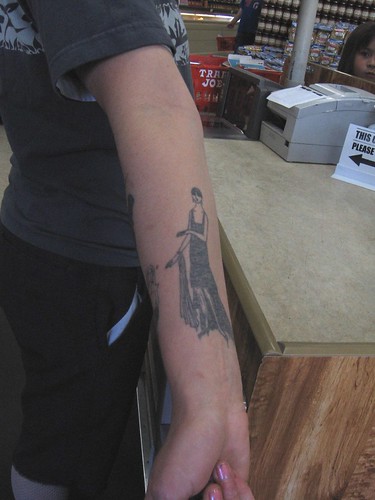
Turns out there are some serious Gorey fans out there. Quite a few people have Gorey engraved onto their skin. Check it out!


So, anyone think we can make this film happen?

Quite!